Every temporary or mobile construction site (estaleiro temporário ou móvel) in Portugal is subject to Decreto-Lei nº 273/2003 de 29 de outubro – the law on safety and health at temporary and mobile construction sites. This decree-law transposes directive 92/57/EEC into national law and regulates the responsibilities of the client, designer, safety coordinator, and contractor. For the main contractor or subcontractor, it serves as a basis for inspection by ACT (Autoridade para as Condições do Trabalho – Portuguese labor inspection) and for organizing work through the PSS (Plano de Segurança e Saúde – safety and health plan) and preliminary notification. Below is what is inspected and where the waterless urinal meets the requirements.
Requirements of Decree-Law 273/2003 and Portaria 101/96
The decree-law divides responsibility among participants. The client (dono da obra) ensures the preparation of the PSS; if there are multiple designers or executors, safety coordinators are appointed: CSP during the design phase and CSO during the execution phase. The main contractor is responsible for the actual availability of sanitary facilities on site and their compliance with the plan.
The composition of sanitary facilities is not regulated by decree-law 273/2003 itself: it requires describing them in the PSS (Annex II, item 13) in accordance with legal requirements. These requirements are contained in Portaria 101/96 of April 3, 1996 (minimum safety and health requirements at temporary and mobile construction sites), which decree-law 273/2003 kept in force (art. 29). Its item 24 requires the presence of toilets, urinals if necessary, and sinks near work areas – separately for men and women (or with separate use), in sufficient quantity, at least one for every 25 workers.
On a construction site with temporary sewer connection or without it, these requirements are met by portable toilets with a holding tank from rental operators.
Preliminary Notification and PSS
If the work will last more than 30 days and at some point, there will be more than 20 workers on site simultaneously, or the total volume will exceed 500 person-days, the client must send a preliminary notification to ACT before starting work (comunicação prévia, art. 15). A copy of the notification is posted on site.
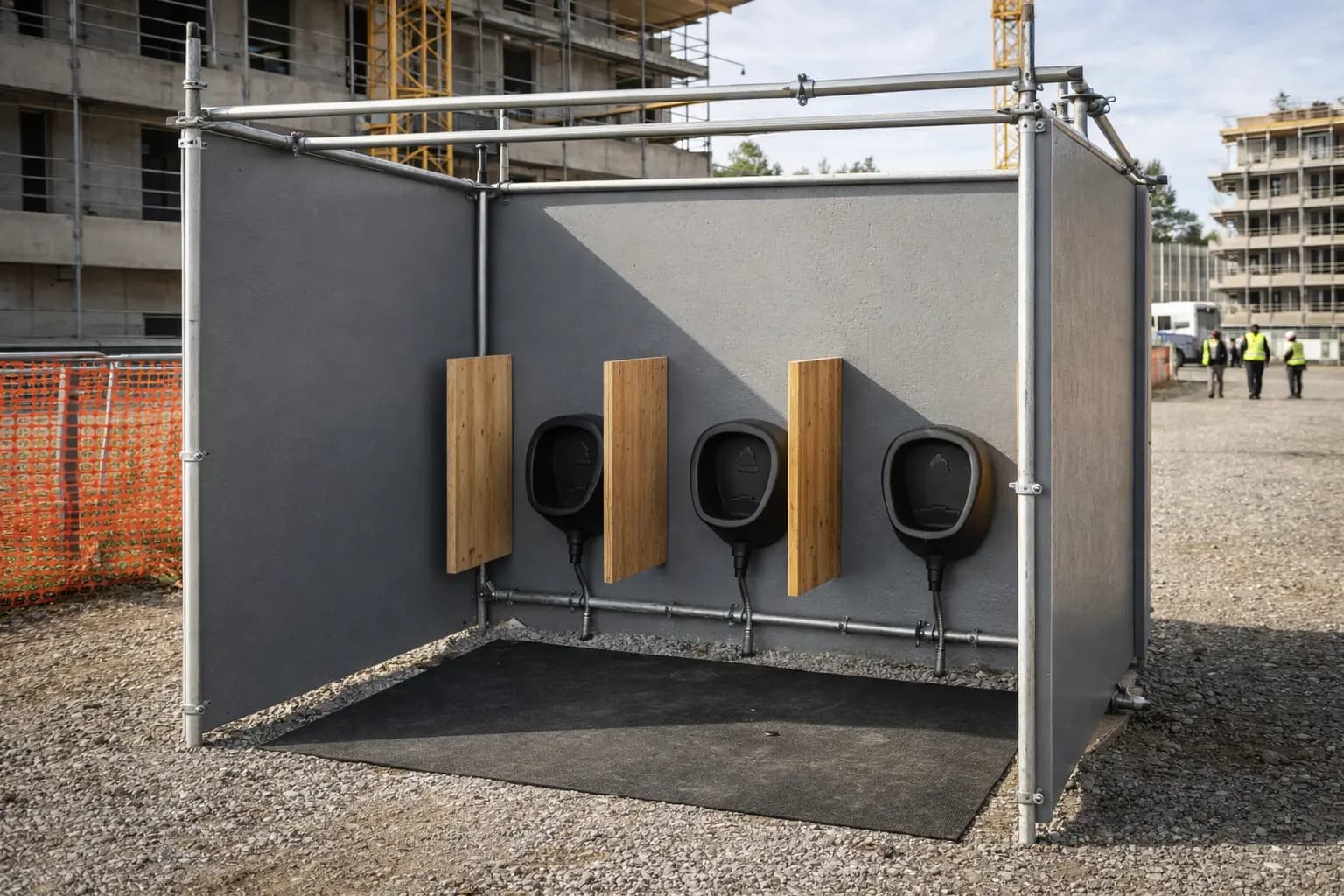
The PSS includes a section on sanitary facilities and changing rooms. For the PSS, Pi-Pi provides a manufacturer’s statement (material, country of origin), product technical specification, a photo of the installed urinal, and a connection diagram to the tank. Documents are sent by email.
ACT Inspection
ACT checks on site: the presence of the PSS and preliminary notification, the actual number of toilets and urinals relative to the workforce, the condition of facilities (cleanliness, ventilation, lighting), separation for men and women. In case of violations, ACT draws up a report; non-compliance with Portaria 101/96 is a serious administrative offense (contraordenação grave), for which a fine is provided. A prepared document package for each sanitary component reduces inspection time.
Urinals and Toilets: Ratio
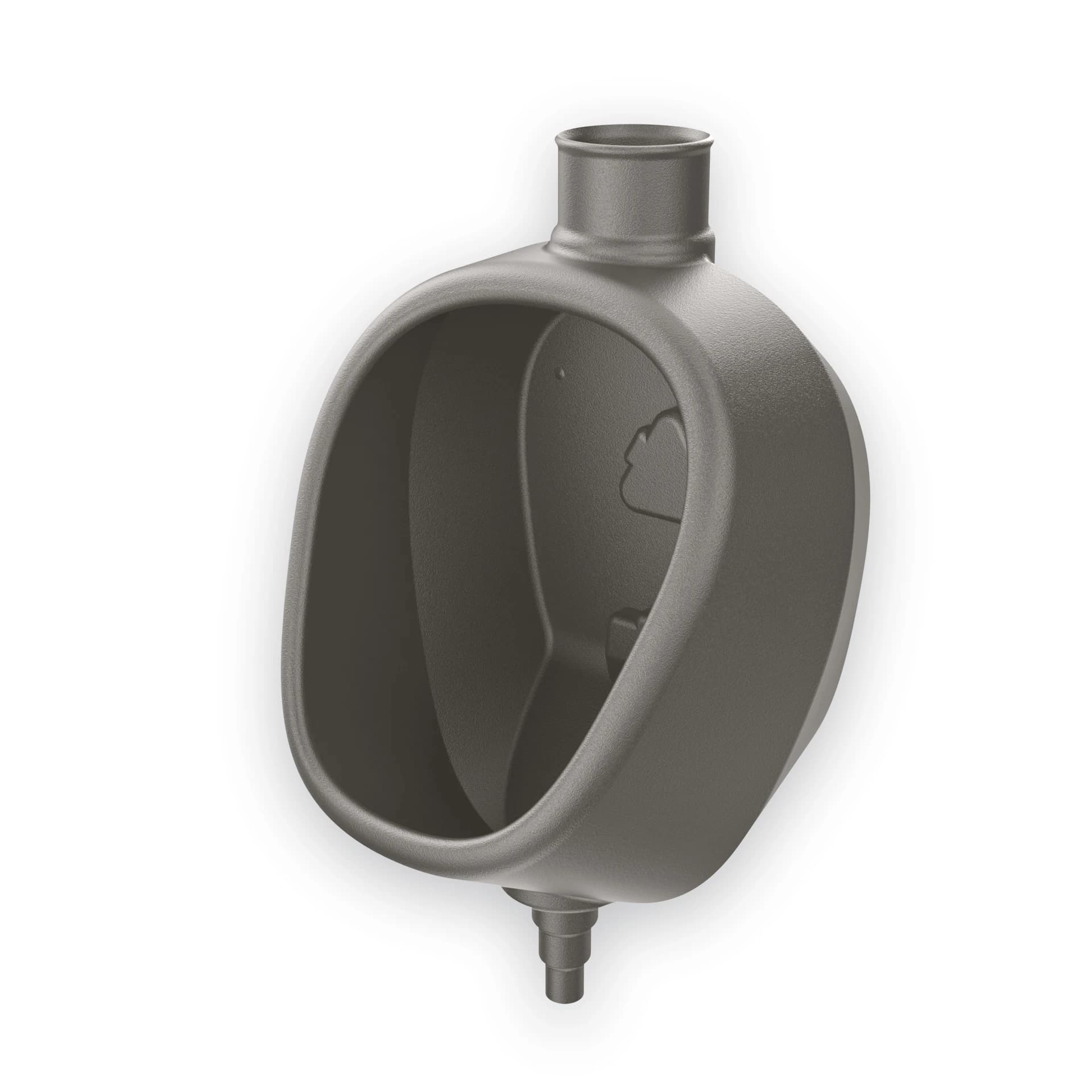
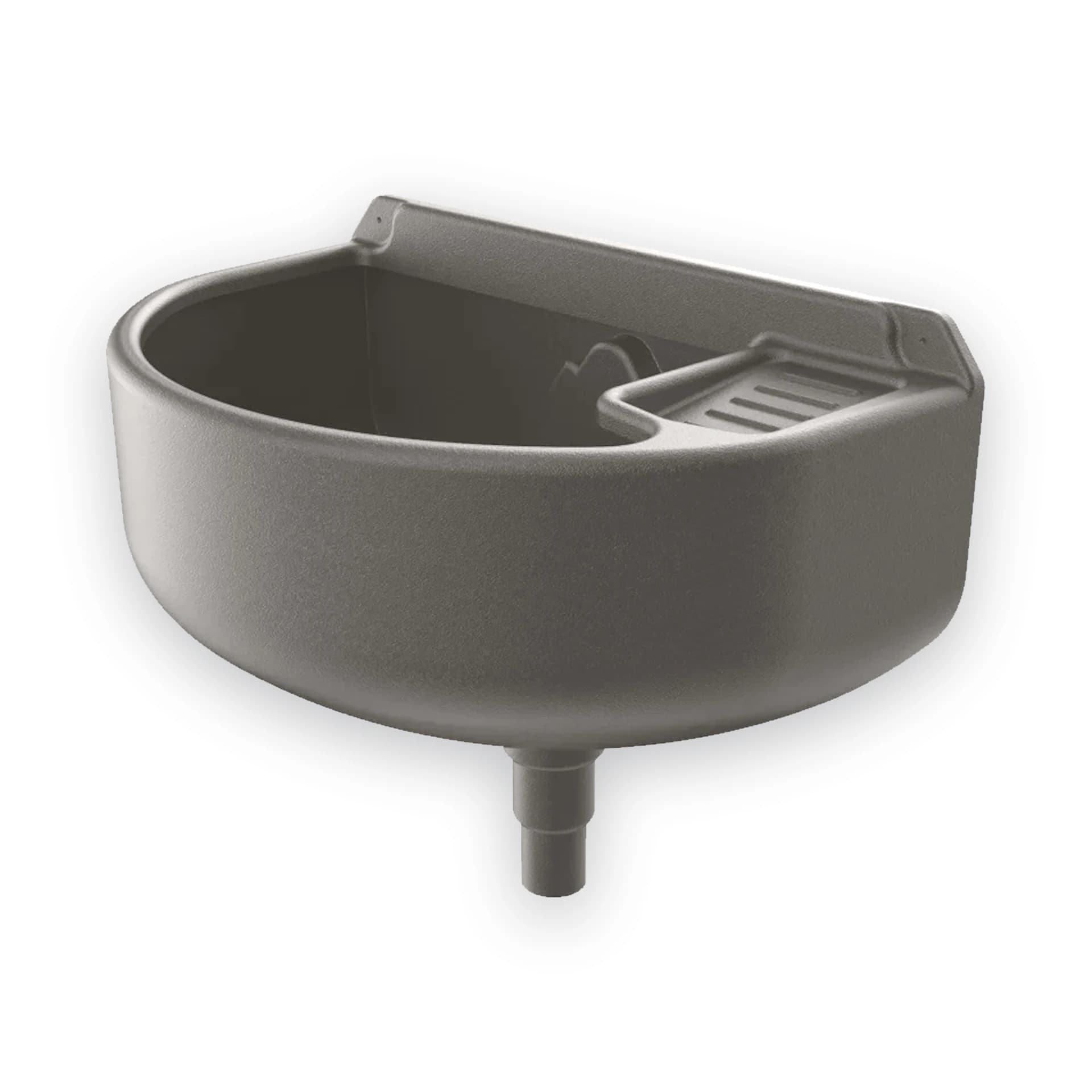
For crews predominantly male – typical for framing, masonry, and roofing work – separate urinals relieve peak load and reduce queue during lunch breaks and shift changes; Portaria 101/96 explicitly provides for urinals. Pi-Pi is mounted on the wall of a portable toilet or inside a modular unit: the stepped connector Ø24/32/40 mm fits hoses and pipes of these diameters. You can check the fit on your cabin’s tank sample.
Climate of Portugal: Algarve and Trás-os-Montes
Portugal is diverse. In the Algarve, coastal Alentejo, and inland Beira, cabins operate in summer at +35…+40 °C in the sun. In Trás-os-Montes, Serra da Estrela, and parts of Beira Alta, winter temperatures drop to −10…−15 °C. The fleet is usually shared – a cabin that spent summer in Faro goes to Bragança in winter.
Homopolymer polypropylene becomes brittle in frost at around 0 °C – it absorbs impact during loading and unloading less effectively. LLDPE Pi-Pi remains flexible down to −40 °C. Under ultraviolet light, polyethylene oxidizes more slowly than polypropylene with comparable stabilization. One material for both climatic poles of the country.
What the Urinal Does Not Cover
Pi-Pi is a component, not a complete solution. Portaria 101/96 requires toilets, sinks, lighting, and hygiene conditions in the module. Pi-Pi covers one point – separate urine collection for men standing.
Conclusion
Decree-law 273/2003 together with Portaria 101/96 is the framework within which every construction site in Portugal operates. Pi-Pi is tailored to this framework: LLDPE remains flexible down to −40 °C and is designed for outdoor use, the stepped connector 24/32/40 mm fits hoses and pipes of these diameters, and for the PSS we provide a manufacturer’s statement and specification. Installation takes 5–7 minutes. For a specific construction site, send a request – I will respond with a calculation and delivery terms.