Every construction site in Hungary falls under the joint decree of the Ministry of Social Affairs and the Ministry of Health ‘4/2002. (II. 20.) SzCsM-EüM joint decree’ – on the minimum occupational safety requirements at construction sites. The decree implements the European Directive 92/57/EEC and works in conjunction with the framework Occupational Safety Act ‘1993. évi XCIII. törvény’. For contractors and general contractors, this is not a guidebook but a basis for site access through the BSZK plan and for occupational safety inspection checks. Non-compliance results not in fines but in work suspension. Below is what is checked and where the waterless urinal meets the requirements.
Requirements of Decree 4/2002 SzCsM-EüM for Welfare Facilities
Appendix 3 of the decree, the section on welfare facilities, obliges the employer to provide a sufficient number of changing rooms, washbasins, toilets, and rest rooms – separately for men and women if there are five or more female employees. The practical calculation: one toilet and one urinal per 10–15 workers. Water supply must be reasonably close. On large sites with temporary connections to utilities or without them, these requirements are met by mobile cabins from TOI TOI Magyarország, BPK Toalett, Mevi Hungary, and regional operators.
Health and Safety Coordinator
Decree 4/2002 introduces the role of the health and safety coordinator – mandatory for sites where two or more crews work or where the total volume of work exceeds a set threshold. The coordinator exists in two roles: during the design phase and during the construction phase. The design phase coordinator is responsible for integrating risks into the project documentation; the construction phase coordinator ensures actual compliance with measures on-site, including welfare facilities.
BSZK – Health and Safety Coordination Plan
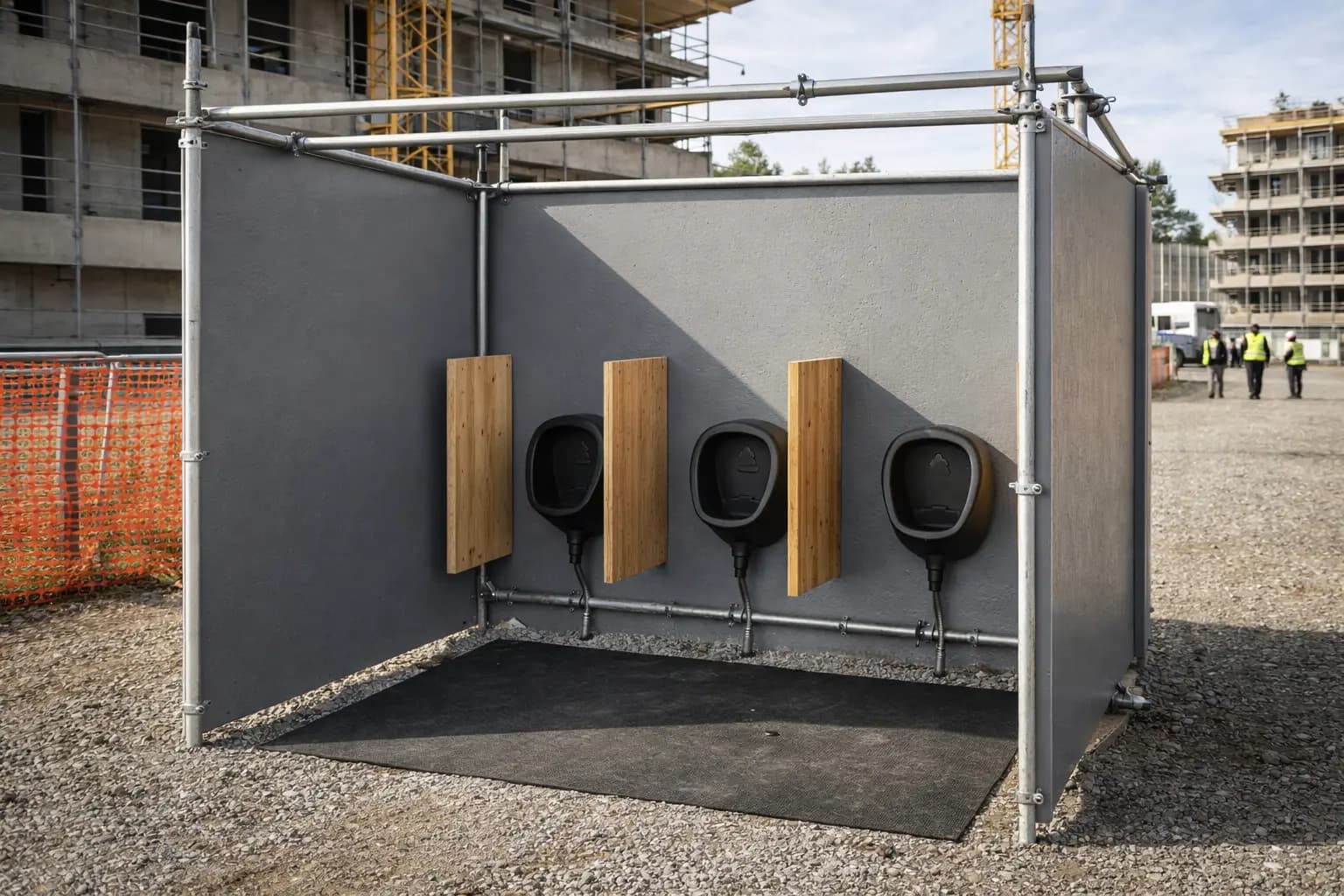
The design phase coordinator develops the BSZK plan (Biztonsági és Egészségvédelmi Koordinációs Terv – Health and Safety Coordination Plan) before work begins. The BSZK plan includes a section on welfare facilities: calculation of the number of toilets and urinals, layout scheme, person responsible for cleaning, frequency of waste removal. Pi-Pi’s standard document package for BSZK: LLDPE material data sheet, REACH/RoHS certificates, photo of installed urinal, connection scheme to the mobile cabin tank. This is sufficient for BSZK and for occupational safety inspection checks.
Calculation of Toilets and Urinals
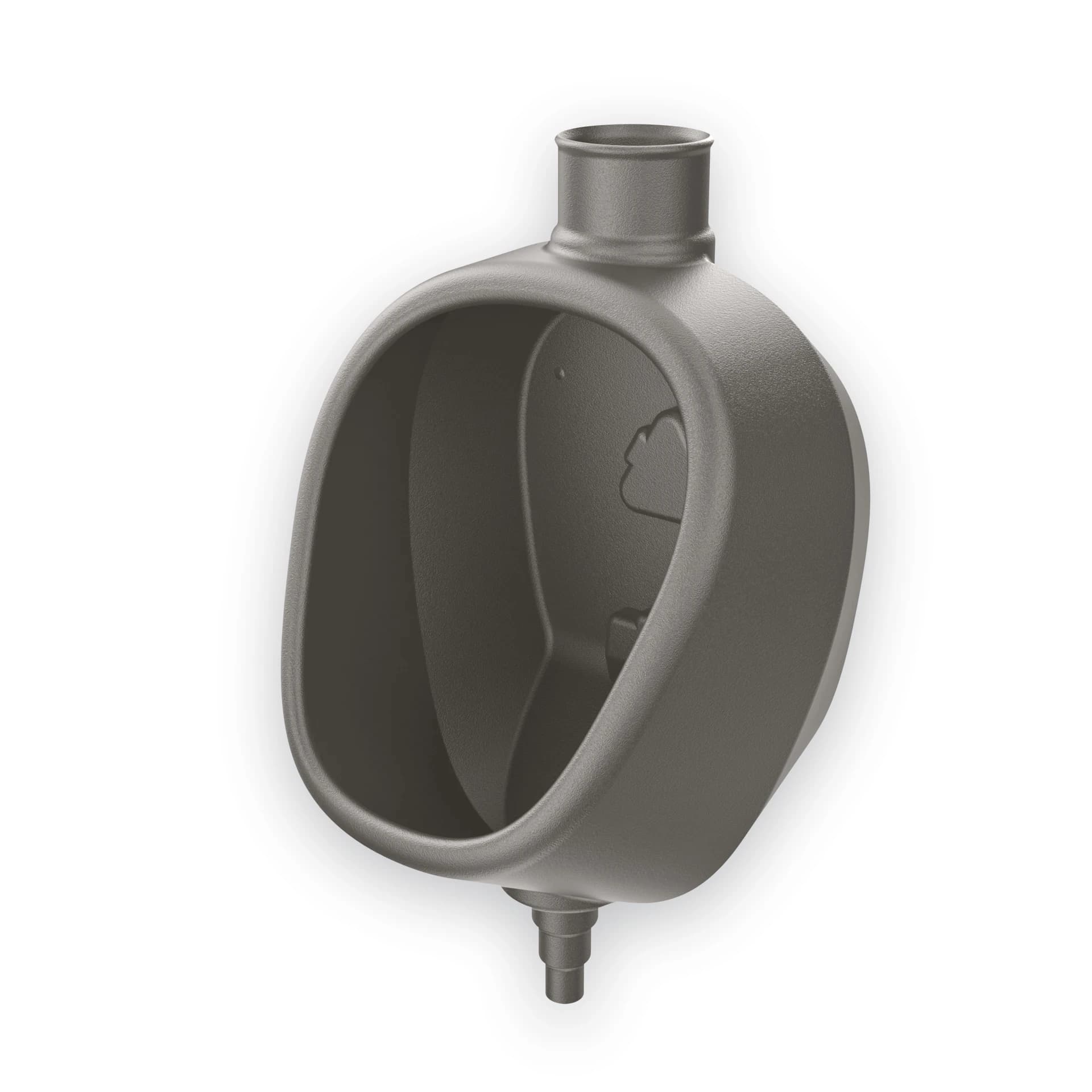
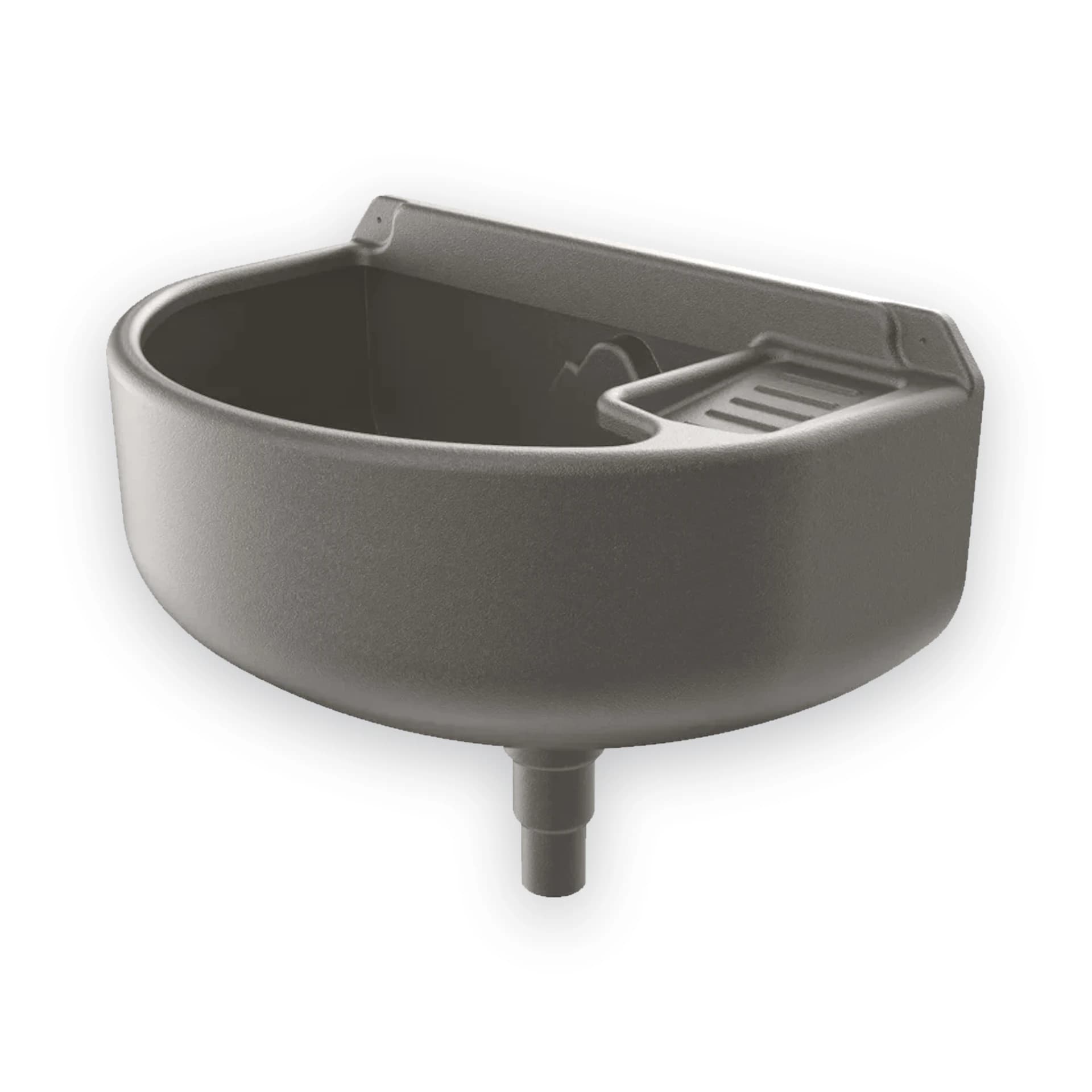
In crews predominantly male – typical for high-rise construction, roofing, reinforced concrete work – it is permissible to replace some toilets with urinals while maintaining the overall calculation according to Appendix 3. One urinal per 15–20 workers reduces queue times at the cabin and saves time during lunch breaks and shift changes. Pi-Pi is mounted on the wall of an existing mobile cabin or inside a modular welfare unit without plumbing alterations: a stepped connector Ø24/32/40 mm connects to the standard tank of any Hungarian cabin manufacturer.
Frost Resistance for Mountain Regions
Hungary is mainly flat, but construction sites in the Matra, Bükk, Zemplén, Bakony mountains, and in the northern counties (Borsod-Abaúj-Zemplén, Nógrád, Heves) operate in winter at −15…−25 °C. Polypropylene in budget urinals becomes brittle around 0 °C and cracks from an installer’s impact or during loading and unloading. LLDPE Pi-Pi retains elasticity down to −40 °C. A fleet that has wintered in Matra can be dispatched to the Great Hungarian Plain in summer without losses.
Compatibility with TOI TOI Magyarország, BPK Toalett, Mevi
The Hungarian mobile toilet cabin rental market is represented by TOI TOI Magyarország, BPK Toalett, Mevi Hungary, Sebach Hungary, and regional operators. All use tanks with a standard 32 or 40 mm inlet. Pi-Pi’s stepped connector (24/32/40) connects to any without adapters. For a contractor with a mixed fleet – one item for spare parts.
Hungarian-German and Hungarian-Romanian Labour Market
The Hungarian construction industry operates in two mobility streams: Hungarian crews move to construction sites in Germany and Austria, Romanian crews enter Hungary through the counties of Bihor, Satu Mare, Arad. The fleet of cabins and components circulates between countries. Pi-Pi operates in a single standard 24/32/40 mm across the EU – a contractor servicing a site in Debrecen today, moving to a project in Bavaria next season, or hosting a Romanian crew does not change the item.
What the Urinal Does Not Do
Pi-Pi is a component, not a complete solution according to Appendix 3. The decree requires a toilet, washbasin, cabin lighting, and heating. Pi-Pi covers one point – separate collection of male urine standing.
Conclusion
Decree 4/2002 SzCsM-EüM is the framework within which every construction site in Hungary operates. Pi-Pi is tailored to this framework: the material does not crack in winter in Matra and Bükk, the fitting is compatible with the fleet of TOI TOI Magyarország, BPK Toalett, and Mevi, documents are ready for the BSZK plan and occupational safety inspection. Installation takes 5–7 minutes. For calculations for a specific site and supply conditions from 100 units, request a quote – we will send the technical sheet, sample documents for BSZK, and supply terms.