
How often should the urinal canister be emptied and how to do it?
How often to empty the urinal canister depends on its volume and the number of users. A guideline for a 10–20 L canister: once every 1–2 weeks for one user and once every 5–7 days for two. It’s better to empty it in advance, not waiting until the canister fills to the neck.
Which Container to Choose
The liquid from the Pi-Pi waterless urinal flows by gravity into a canister through a stepped outlet Ø24/32/40 mm and hose. Any container that is convenient for you to use will do. Pay attention to three things:
- volume: the more users, the larger the canister needed or the more often it will need to be emptied;
- neck: the hose of the required diameter should fit freely into it;
- tight lid and convenient handle: makes it easier to carry the canister and reduces odor.
If you use the urinal with a dry toilet, the liquid can also be directed into its liquid fraction container: the connection systems vary, so choose the outlet step by the hose diameter.
How Often: Guidelines
| Situation | Guideline |
|---|---|
| One user, 10–20 L canister | once every 1–2 weeks |
| Two users, 10–20 L canister | once every 5–7 days |
This is a guideline, not a guarantee: the actual frequency depends on the canister volume, the number of users, and guests. It’s easiest to focus on the level in the canister and empty it when it’s about two-thirds full. If the canister is opaque, mark the level on the wall or set a reminder for emptying in advance.
How to Empty
- Prepare gloves and a place to pour out the contents.
- Disconnect the hose from the canister or lift its end to prevent liquid from spilling on the floor.
- Close the canister with a lid and take it out.
- Empty the canister in an approved place.
- Rinse the canister with water and wash your hands.
- Return the canister to its place, insert the hose into the neck, and ensure it runs downward without sags.
Where to Dispose of the Contents
Where to pour out the contents is determined by the rules of your plot, garden association, or municipality. This may be a common association receiver, storage container, compost reservoir, or sewage system if connection to it is allowed. For what to consider if you are thinking about using it in the garden, read the answer can collected urine be used in the garden.
How to Prevent Overflow
- Place the canister below the urinal outlet, and lay the hose downward without sags.
- The end of the hose should be inserted into the neck, not lying next to it.
- Empty the canister before it fills up, especially before guests arrive and before leaving the plot.
- If it’s time to replace the canister with a larger one, choose a container with a volume reserve.
Odor appears where liquid stagnates. Regular emptying, a tight lid, and rinsing the canister help avoid it, more details – in the answer how to remove odor. See urinal models in the catalog: Pi-Pi waterless urinals.
Suitable Models
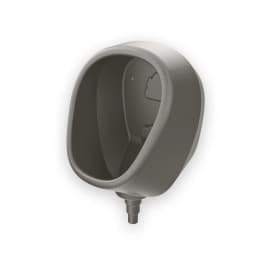
Pi-Pi Standard
Closed-top body – the simplest way to add a standing urinal to a shed or cabin that doesn’t need a vent.
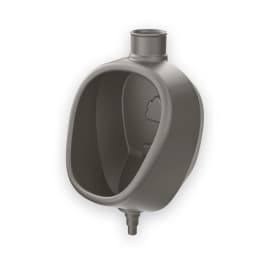
Pi-Pi Standard Plus
Top port Ø70 mm connects directly to the standard ventilation of a composting toilet – for a closed cottage, allotment, or campervan where ventilation is needed.
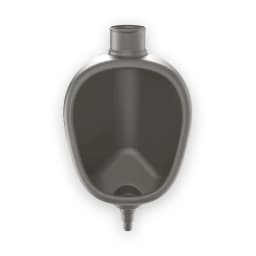
Pi-Pi Standard Corner
Corner shape plus top port Ø70 mm for ventilation – standing urinal even in the tightest cottage.
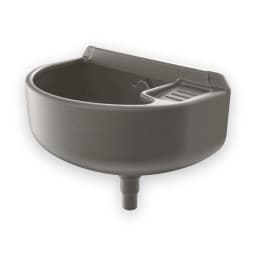
Pi-Pi Outdoor Sink
Durable plastic sink for allotments, garages, and workshops – impact-resistant and frost-proof. Comes with a soap shelf.
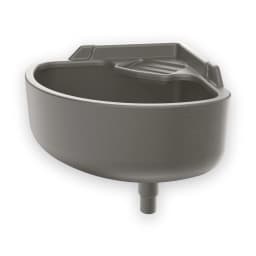
Pi-Pi Outdoor Corner Sink
The same durable plastic sink, but for corners – to save space in tight workshops or cabins.
Related Questions
Have Questions?
Got a question? Message me – I’ll help you pick the right model for your garden shed or toilet setup and sort out delivery. I respond within one business day.

Mart Tamm
Account Manager for United Kingdom
Have questions about products, pricing, or partnership? Email me directly – I’ll respond personally.