
What are the advantages of rotational moulding?
Rotational molding provides a seamless wall thickness of 4–5 mm without welds and joints: there are no pre-set weak points in the product. This is how Standard and other Pi-Pi waterless urinals, as well as plastic sinks, are made.
How the product is made by rotomolding
LLDPE powder is loaded into a closed mold. The mold rotates on two axes in an oven at 280–310 °C, and the melt evenly covers the entire inner surface. When the material cools, the mold is opened and the finished product is removed: solid, with a 4–5 mm wall thickness throughout.
Seamless wall: what it offers in maintenance and operation
- No seams or joints, meaning there is no line along which the product could separate. Therefore, the urinal and sink withstand impacts during installation and transportation well.
- The surface is smooth and wipes clean in seconds.
- The wall thickness is uniform throughout the product.
How it differs from injection molding
Injection molding and rotomolding are two different processes. In injection molding, the melt fills the mold under pressure, and where its flows meet, weld lines can form – areas that may be weaker than the rest of the wall. In rotomolding, the melt is not forced into the mold but gradually covers it from the inside, so the wall forms entirely, without welds or seams.
What this means for you
The product is lightweight (1.4–1.5 kg) yet strong: one person can hang it on the wall, and an impact during installation does not hit a seam because there is no seam. Combined with a material that does not crack in frost down to −40 °C, this makes the urinal or sink suitable for an unheated cottage, allotment shed, or garage. Why LLDPE was chosen is explained in the response about the difference from HDPE, and how to care for the smooth surface is in the response about maintenance.
Suitable Models
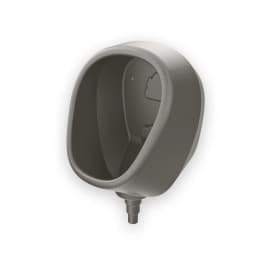
Pi-Pi Standard
Closed-top body – the simplest way to add a standing urinal to a shed or cabin that doesn’t need a vent.
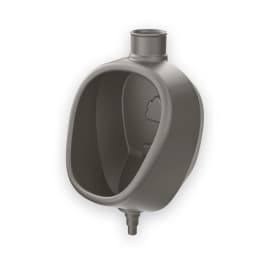
Pi-Pi Standard Plus
Top port Ø70 mm connects directly to the standard ventilation of a composting toilet – for a closed cottage, allotment, or campervan where ventilation is needed.
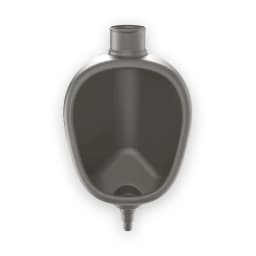
Pi-Pi Standard Corner
Corner shape plus top port Ø70 mm for ventilation – standing urinal even in the tightest cottage.
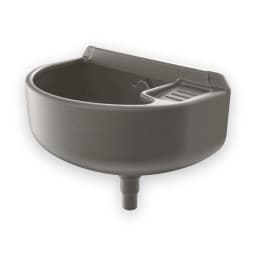
Pi-Pi Outdoor Sink
Durable plastic sink for allotments, garages, and workshops – impact-resistant and frost-proof. Comes with a soap shelf.
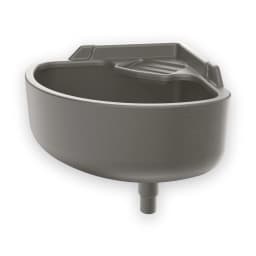
Pi-Pi Outdoor Corner Sink
The same durable plastic sink, but for corners – to save space in tight workshops or cabins.
Related Questions
Have Questions?
Got a question? Message me – I’ll help you pick the right model for your garden shed or toilet setup and sort out delivery. I respond within one business day.

Mart Tamm
Account Manager for United Kingdom
Have questions about products, pricing, or partnership? Email me directly – I’ll respond personally.