Where does the water from the sink go without sewage, and is a plumber needed?
The Pi-Pi sink is a simple wall-mounted bowl without a sewage connection. Water drains by gravity through a stepped connector Ø24/32/40 mm, and then you choose where to direct it:
- into a bucket or jerry can placed directly under the sink — the most common option for garages, garden cottages, and camping
- into a short hose or pipe leading to a drain, sump, or garden bed
No plumber needed. The sink hangs on two mounts, and the drain is a piece of flexible hose on the connector. Everything assembles in a few minutes with a screwdriver, no soldering or pipe cutting required. Water is supplied to the sink from a nearby jerry can or tank — it has no built-in tank or pump.
Suitable Models

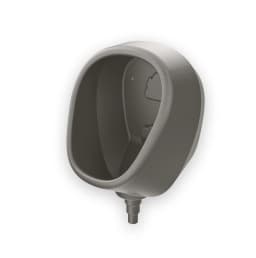
Pi-Pi Standard
Closed-top body — the simplest way to add a standing urinal to a shed or cabin that doesn't need a vent.

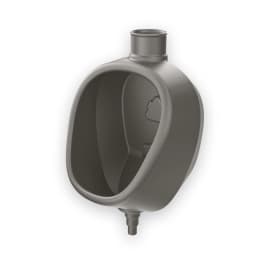
Pi-Pi Standard Plus
A Ø70 mm port on top ties straight into your composting toilet's existing vent — for an enclosed shed, cabin or van where smell has nowhere to escape.

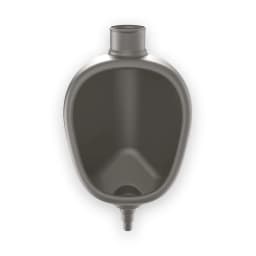
Pi-Pi Standard Corner
Corner shape plus top port Ø70 mm for ventilation — a urinal even in the tightest cabin, and odor-free.

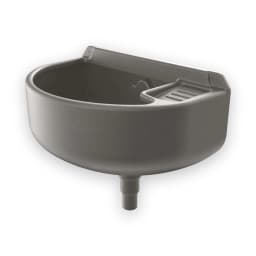
Pi-Pi Outdoor Sink
Durable plastic sink for cottages, garages, and workshops — shatterproof and frost-resistant. Comes with a soap shelf.
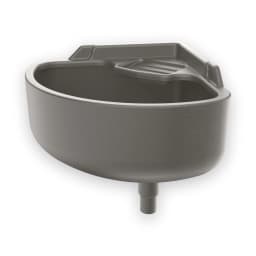
Pi-Pi Outdoor Corner Sink
The same durable plastic sink, but for corners — to save space in tight workshops or cabins.
Related Questions
We make the Pi-Pi urinal from LLDPE (linear low-density polyethylene) because it stays tough and flexible even in the cold — ideal for an unheated garden shed or cabin.
What LLDPE means for you:
- Frost-safe: stays flexible down to −40 °C and won't crack, whereas HDPE turns brittle in the cold
- Impact-resistant: shrugs off knocks during transport and fitting without breaking
- Robust: copes better with rough handling and cleaning products
HDPE is a little more chemical- and UV-resistant, but for year-round outdoor use in the garden the flexibility and frost-resistance of LLDPE matter more — you want the urinal to come through the winter in one piece.
LLDPE and PP (polypropylene) are made for different conditions. PP is stiffer and more heat-resistant — but for the Pi-Pi urinal in the garden, LLDPE is the better choice, especially through the colder months.
Why LLDPE wins for you:
- Frost-safe: LLDPE stays flexible down to −40 °C, while PP turns brittle in even light frost and can crack
- Impact-resistant: LLDPE gives and springs back, PP can crack on a knock
- Worry-free: no risk of finding the urinal cracked in the shed after a cold winter
PP pays off mainly where things are sterilised at high temperatures or kept permanently warm and indoors. For year-round use in the garden, LLDPE comes out on top.
The Pi-Pi urinal is made by rotational moulding — which brings real, everyday benefits:
- Moulded in one piece: seamless, with no glued joints — no weak spots and no crevices for bacteria to gather
- Even wall thickness: 4–5 mm all round, including corners and edges
- Holds its shape: won't warp, even after years of use
- Impact-resistant: the continuous material structure copes well with knocks and drops
There are two versions of the Pi-Pi urinal — the only difference is the top connection:
- Standard: closed top, completely waterless — the right choice for most garden sheds and cabins.
- Standard Plus: with a top inlet Ø70 mm. You can connect a vent pipe to it, or link it to the ventilation hose of your separating toilet — so the air inside stays fresh.
Go for Standard Plus if you want to run a vent to the outside; otherwise the Standard model is all you need.
The Pi-Pi urinal has a stepped outlet spigot (Ø24 / 32 / 40 mm). You simply cut it to the step you need and connect it however suits you: to a canister, a holding container, or straight to the liquid tank of your separating toilet. Common hose and pipe sizes fit without any special adapters.
Made from industrial LLDPE, the Pi-Pi urinal is rated on its datasheet for −40 °C to +60 °C. In the garden that means year-round outdoor use in any European climate — an unheated shed in winter is no problem. For everyday frost-resistance we work to a conservative −40 °C.
The Pi-Pi urinal is made from LLDPE, which is very resistant to chemicals and gets on fine with almost any household or garden cleaner you already keep in the shed.
Perfectly fine:
- ordinary all-purpose and bathroom cleaners
- diluted acids (citric acid, vinegar, vinegar cleaner)
- diluted alkalis (mild soap solution, ammonia)
- alcohols (isopropanol 70%, ethanol)
- biodegradable cleaners — ideal if you reuse the urine as fertiliser
Use sparingly and rinse well:
- concentrated bleach
- solvents such as acetone (rinse off straight away)
Don't use:
- concentrated acids (sulfuric acid, strong HCl)
- aggressive solvents (petrol, kerosene, paint thinner)
Tip: a simple household cleaner is all you need. If you reuse the urine in the garden as fertiliser, a biodegradable product is the best choice.
You can install the Pi-Pi urinal yourself in 5–7 minutes — no plumber or special tools needed. An illustrated step-by-step guide (PDF) is available on the product page.
It's simple:
- Mount to the wall: a mounting plate is included (corner models don't have one), and you should select screws and plugs suitable for your wall — whether it's a garden cottage, shed, or toilet cabin
- Connect the drain: trim the stepped nozzle Ø24/32/40 mm to the required step and direct the hose into a canister, collection container, or liquid tank of a separating toilet
- Eliminate odors: the waterless trap keeps the air fresh
- No water needed: the urinal is completely waterless, no plumbing connection required
Next to a composting toilet: place the Pi-Pi right next to a separating or dry toilet. This way, urine goes into its own canister, the main toilet container fills 2–3 times slower, stays drier, and smells less.
The full installation guide (PDF) is available on each product page.
No — in normal use there's no smell, and that's the big difference from a bucket. The urine drains straight into a sealed container, so no standing liquid is left in the urinal to go stale. It's that stale, standing liquid that causes the smell, and here there simply isn't any.
The Standard Plus model has a Ø70 mm vent port on top: connect a vent pipe to it and any residual odour is carried outside. That's enough to use it happily even inside a garden shed or cabin. Just rinse the bowl occasionally and you're done.
It runs on gravity alone — no water, no electricity, no plumbing. The urinal screws to the wall and the urine simply drains down through the stepped outlet into a canister, or straight into the liquid tank of your separating toilet.
There's nothing to flush, no pump and no pipework to lay. When the container is full you lift it out and empty it — that's the whole of the maintenance. Have a look at the models in the urinal catalogue.
The urinal can be mounted on any wall at a height convenient for you — it's lightweight (~1.4 kg), so it holds even on a thin wall of a garden shed or site cabin. No wet work required.
A hose runs down from the nozzle — into a canister or directly into the liquid tank of a composting/separation toilet. It also works in unheated structures: the material is frost-resistant down to −40 °C, so wintering at the cottage is not a problem.
Have Questions?
Got a question? Message me — I'll help you pick the right model for your garden shed or toilet setup and sort out delivery. I respond within one business day.

Mart Tamm
Account Manager for United Kingdom
Have questions about products, pricing, or partnership? Email me directly — I'll respond personally.